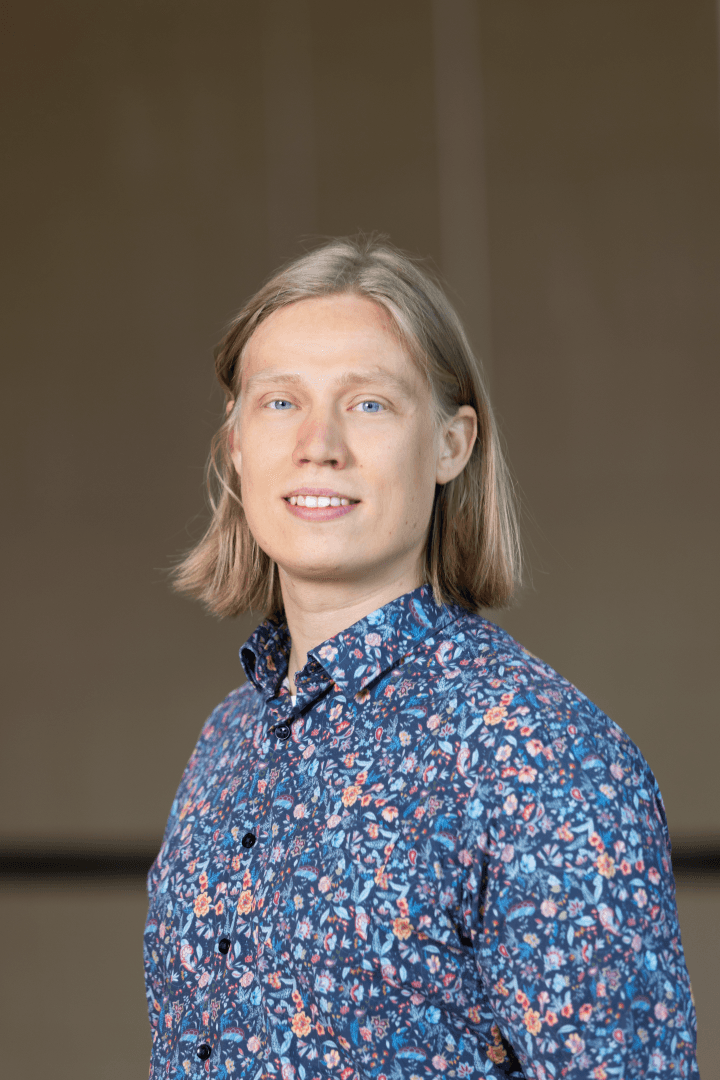
about
I am a philosopher of science, working as a Doctoral Research Fellow at the University of Oslo with the AssemblingLife project.
I work on the science of pattern formation and how it explains, models and conceptualizes common causal architectures shared by diverse shapes, structures, and behaviours in the life-sciences.
Education
University of Oslo
Doctoral Research Fellow | Jan 2024 – Present
I study how scientists explain and model the formation of intricate patterns in the life sciences. My dissertation is about self-assembly and its interaction with self-organization in shaping biological organization.
University of Aarhus
Master in Philosohy | Sept 2020 – June 2023
Specialized in cognition, metaphysics and social epistemology. Wrote my thesis on the connection between biological organization and cogntive processing.
Publications
Peer Reviewed:
Sander-Oest, S. Patterns of life: how to differentiate between self-assembly and self-organization. Synthese 208, 143 (2026).
https://doi.org/10.1007/s11229-026-05793-6
Sander-Oest, S. (2026). A processual account of scientific definitions. European Journal for Philosophy of Science, 16(3), 68.
https://doi.org/10.1007/s13194-026-00769-2
Sander-Oest, S. (2026). Spontaneous contexts: Explanatory diversity in biological self-assembly. Studies in History and Philosophy of Science, 118, 102174.
https://doi.org/10.1016/j.shpsa.2026.102174
Sander Oest, S. Life-mind continuity: untangling categorical, extensional, and systematic aspects. Synthese 203, 187 (2024).
Public Dissemination
“Passiv, Aktiv og Levende Materie”, Tidskriftet Paradoks, 13. September 2024
Interested in some of my projects and want to read work-in-progress? Feel free to contact me!
project details
The Science of Self-Assembly
Soap-bubbles, crystals and ant colonies; self-assembly is everywhere, yet few know what self-assembly is and how it became an important scientific concept.
In my work, I have explored the epistemology and history of self-assembly, arguing that it emerged as a key concept in the formation of molecular biology and as a fundamental principle of biological organization. Since then, chemists have been drawn to the intricate and delicate architectures found in living systems and seek to replicate self-assembly through nanofabrication methods.
Now, self-assembly lies at the forefront of understanding how life can perform work.

Pattern formation and Biological complexity
Why is the world not boring?
Stripes, branches, spirals: the world is full of interesting shapes. One reason for this is that order can emerge spontaneously through a process known as self-organization.
In recent work I have analyzed the epistemological role of self-organization in the scientific study of complexity. Especially in developing organisms, self-organization is part of a growing appreciation that genetic, molecular and emergent physical forces collectively interact to give rise to tissues and organs.
How do we integrate self-organization into existing research pipelines in developmental biology and what can it teach us about the causal complexity of life? These are pressing philosophical questions.

Conceptual practice in the sciences and in philosophy
How can we come to know the world through concepts?
In my work I have advocated for a pragmatist account of epistemology. We are bounded finite creatures that communally come to know the world through tool-mediated interactions. An appropriate philosophical understanding of science should therefore attend to how concepts are embedded within social systems, by which practices they make contact their target phenomena, and which aims they serve.
Philosophy contributes to science by clarifying its conceptual foundations and by relating its practices and knowledge to the existential conundrum within which mortal creatures find themselves embroiled.
Principles of Bio-cognitive Organization
How is the mind connected to the body? I have approached this question by applying models of complexity from the life sciences to theoretical frameworks of cognition.
My work on life-mind continuity within enactivist approaches to cognition argues that existing accounts of the relationship between life and mind overlook several important distinctions. To address this, I have proposed a classificatory framework to guide future research.
More recently, I have shifted toward a medical focus in collaboration with Aarhus University Hospital. Together, we have been investigating functional somatic disorders, contending that these conditions challenge prevailing conceptions of disease and call for more nuanced accounts of how cognition and experience influence physiology.
contact details
sebaso@uio.no
location
Oslo, Norway
Sebastian Sander-Oest